
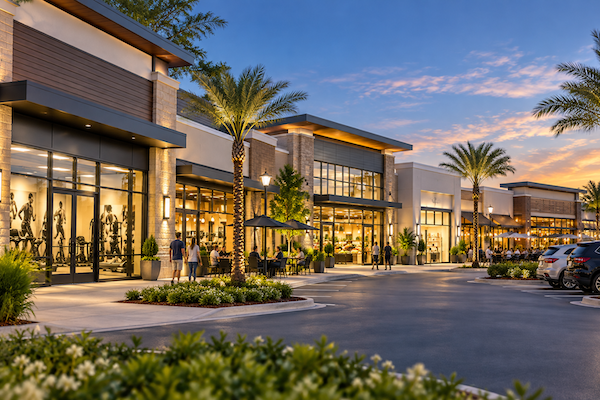
The rules for successful retail shopping centers are changing. For decades, department stores and apparel retailers served as the primary anchors for neighborhood and lifestyle shopping centers. Today, the most successful properties are increasingly built around fitness, wellness, grocery, restaurants, and value-oriented retailers.
According to an August 2026 report by Placer.ai entitled The New Tenant Mix Playbook, consumer shopping patterns have fundamentally shifted, creating both opportunities and challenges for commercial real estate owners, developers, and investors.
The Decline of Traditional Retail Anchors
Between 2019 and 2025, visits to traditional apparel retailers declined nearly 25%, reflecting the continued impact of e-commerce and changing consumer preferences.
Meanwhile, several other retail categories experienced significant increases in customer traffic:
- Health and Wellness: Up 31.8%
- Off-Price and Value Retail: Up 28.6%
- Coffee Shops: Up 26.7%
- Fitness Centers: Up 22.6%
- Grocery Stores: Up 13.8%
These trends suggest that shopping centers anchored by service-oriented businesses may be better positioned to attract customers consistently than properties dependent on traditional apparel retailers.
Fitness and Wellness Are Becoming the New Anchors
One of the report's most compelling findings concerns how frequently customers visit different retailers.
The average gym customer visits approximately 4.2 times per month, compared with 2.5 visits for coffee shops, 2.4 for grocery stores, and just 1.2 for traditional apparel retailers.
For shopping center owners, this distinction is significant. Tenants that attract repeat customers create additional opportunities for neighboring businesses to capture sales.
Equally important, fitness centers, medical spas, wellness providers, and restaurants deliver services that cannot easily be replaced by online shopping.
Not All Shopping Centers Are Created Equal
The report distinguishes between two important retail property categories.
Neighborhood Shopping Centers: Grocery stores remain the foundation, generating more than half of visits across the categories analyzed. However, owners can enhance property performance by incorporating fitness centers, coffee shops, fast-casual restaurants, and wellness providers.
Lifestyle Shopping Centers: Restaurants, entertainment, wellness, and experiential retailers are increasingly important. The objective is not simply attracting customers but encouraging them to remain at the property longer and visit multiple businesses.
Importantly, tenant selection should reflect neighborhood demographics. Premium concepts such as Life Time Fitness and Nordstrom Rack generally serve higher-income trade areas, while Planet Fitness, Ross, and similar value-oriented retailers target a broader customer base.
What Does This Mean for Commercial Real Estate Financing?
From a commercial mortgage underwriting perspective, the evolving retail tenant mix deserves careful consideration.
Lenders traditionally evaluate occupancy, tenant creditworthiness, lease terms, rental income, and debt service coverage. Those fundamentals remain essential. However, the changing retail landscape introduces additional considerations.
A well-positioned shopping center with complementary tenants, recurring customer traffic, and limited exposure to e-commerce disruption may offer stronger long-term leasing prospects.
Conversely, properties heavily dependent on declining retail categories may face increased vacancy, tenant rollover, and refinancing challenges.
The Bottom Line
Retail shopping centers are not disappearing. They are evolving.
For owners and investors, the opportunity lies in understanding which tenants attract customers, how frequently those customers return, and whether the property's tenant mix supports sustainable long-term demand.
As lenders become increasingly selective, a thoughtful tenant mix combined with strong sponsorship, realistic underwriting, and an appropriate capital structure can make a meaningful difference in financing outcomes.
At Bison Financial Group, we understand that successful commercial real estate financing begins with understanding the underlying property, its tenants, and its market. Our experience arranging commercial real estate financing helps owners and investors navigate an evolving lending environment.
Source: Placer.ai, The New Tenant Mix Playbook, August 2026.
Author: Jared Repka 
About the Author:
Jared Repka is the Co-Founder of Bison Financial Group in St. Petersburg, FL.
Bison arranges debt and equity financing for commercial real estate investors and developers.
Bison has relationships with investors across the risk spectrum funding acquisitions, renovations, and new construction.
Click to learn more about:
Bison Financial Group